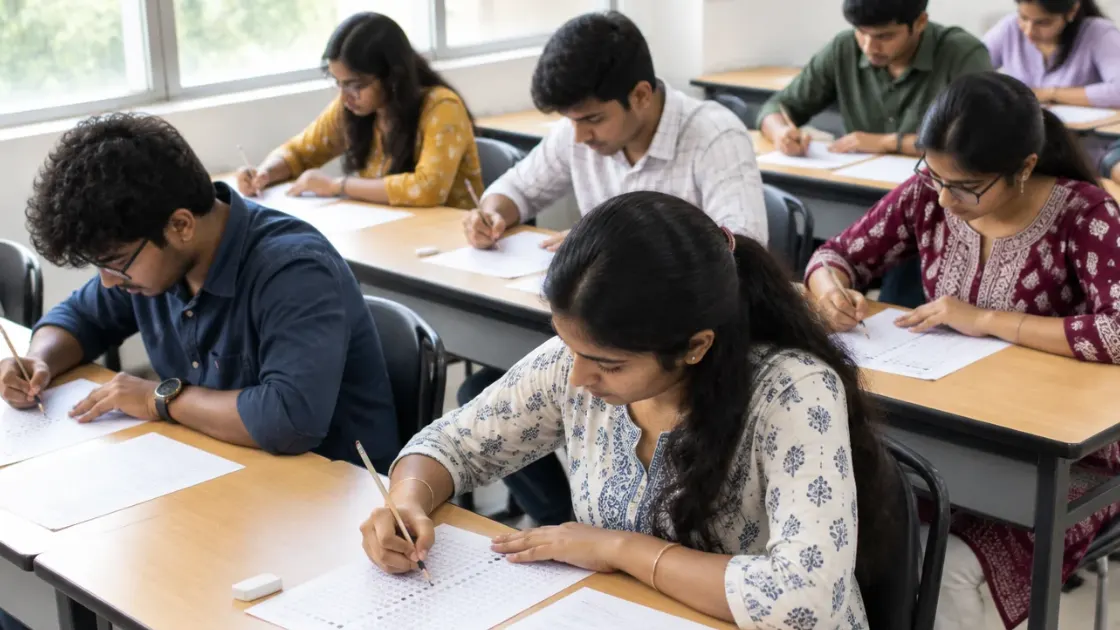



Starting JEE preparation in Class 11 is one of the most important decisions for an aspiring IIT student. Class 11 gives you something that becomes increasingly valuable as JEE approaches: time to build properly.
But starting early does not automatically mean preparing correctly. Many students make the same mistakes. They collect too many books, watch endless lectures, try to study for 10–12 hours from day one, or jump directly into extremely difficult questions.
A better approach is to build your preparation systematically. In this guide, we explain how to study Physics, Chemistry and Mathematics, how much practice you need, when to start PYQs, how to test yourself and how to build a two-year JEE preparation strategy.
What is the right time to start JEE preparation?
There is no single “perfect” starting date. However, starting JEE preparation in Class 11 gives students enough time to:
- Build strong fundamentals
- Complete the syllabus systematically
- Practise JEE-level questions
- Develop problem-solving skills
- Revise Class 11 before Class 12
- Attempt PYQs
- Take regular mock tests
- Identify and improve weak areas
Starting early only helps if you use the extra time effectively.
What does JEE preparation actually require?
JEE Main and JEE Advanced preparation is not simply about studying for more hours. A strong JEE aspirant needs to develop four core abilities:
Conceptual understanding
Understand why a concept works rather than simply memorising a formula.
Problem-solving ability
Apply concepts to questions that may look different from what you studied in class.
Speed and accuracy
Knowing the answer is not enough. You must solve correctly under time pressure.
Error analysis
Understand why you made mistakes and prevent them from repeating.
This is why an effective JEE preparation system should follow:
- Learn
- Practise
- Test
- Analyse
- Improve
How to start JEE preparation in Class 11: step by step
1. Understand the JEE syllabus
Before creating a timetable, understand what you actually have to study.
Physics
Mechanics, thermodynamics, waves, electricity, magnetism, optics, modern physics and more.
Chemistry
Physical Chemistry, Organic Chemistry and Inorganic Chemistry.
Mathematics
Algebra, coordinate geometry, calculus, trigonometry, vectors, probability and more.
Don’t try to finish everything immediately. Instead, divide the syllabus into manageable academic milestones.
2. Build strong Class 11 fundamentals
Class 11 is not a year to rush through. It is the foundation of your two-year JEE preparation. Your first priority should be:
- Understand
- Practise
- Strengthen
For every chapter:
- Learn the concept
- Solve basic questions
- Move to application-based problems
- Attempt JEE-level questions
- Take a test
- Analyse your mistakes
- Revise
This prevents a common problem: completing chapters without actually mastering them.
3. How to study Physics for JEE
Physics requires conceptual understanding and application. A useful learning cycle is:
- Concept
- Visualisation
- Formula
- Application
- Problem solving
Don’t simply memorise formulas. For every important formula, ask:
- What does it represent?
- When can I use it?
- What assumptions are involved?
- What happens if the conditions change?
Then solve progressively difficult problems:
- Basic questions
- Application questions
- JEE Main questions
- JEE Advanced questions
- PYQs
4. How to study Chemistry for JEE
Chemistry requires a different approach for each section.
Physical Chemistry
Concepts + formulae + numerical practice
Organic Chemistry
Concepts + reaction understanding + mechanisms + practice
Inorganic Chemistry
Concepts + NCERT + repeated revision
The mistake is treating all three parts of Chemistry exactly the same way.
Your strategy should change according to the nature of the topic.
5. How to study Mathematics for JEE
Mathematics cannot be mastered by watching lectures alone.
You learn Mathematics by solving Mathematics.
- Concept
- Solved example
- Basic problems
- Application problems
- JEE Main questions
- JEE Advanced questions
- PYQs
If you get stuck, don’t immediately look at the solution. First ask: which concept or step am I unable to identify? That process develops actual problem-solving ability.
6. Create a realistic JEE study timetable
You don’t need an unrealistic 12-hour timetable. A timetable should account for college, coaching, homework, self-study, revision, tests, sleep and breaks.
Your independent study should cover all three JEE subjects regularly. A simple structure could be:
| Block | Focus |
|---|---|
| Physics | Concept + problem solving |
| Chemistry | Theory + questions + revision |
| Mathematics | Problem solving |
| Daily revision | Formulae + mistakes + previous concepts |
The exact number of study hours should depend on your schedule and current level.
Consistency matters more than extreme study hours.
7. Follow a two-year JEE preparation strategy
A good JEE roadmap should not treat Class 11 and Class 12 as two disconnected years.
-
Class 11 foundation
Build strong fundamentals in Physics, Chemistry and Mathematics. Focus on concepts, basic practice and problem solving.
-
Advanced practice
Once fundamentals are strong, gradually increase difficulty: basic → moderate → JEE Main → JEE Advanced. Don’t jump directly to the hardest questions.
-
Class 11 revision
Before moving too far into Class 12, identify weak Class 11 chapters. Use revision, mixed practice, PYQs and tests.
-
Class 12 + Class 11 integration
While learning Class 12, continue revising Class 11. This prevents the entire Class 11 syllabus from becoming a last-minute revision burden.
-
JEE Main preparation
Focus on PYQs, speed, accuracy, revision, full-syllabus tests and mock examinations.
-
JEE Advanced preparation
Increase focus on multi-concept problems, unfamiliar problems, advanced-level questions, full-length tests, problem selection and examination strategy.
8. Start solving JEE PYQs early
Previous Year Questions are one of the most useful resources for understanding the actual examination. PYQs help you understand question patterns, important concepts, difficulty level, application of concepts and your current preparation level.
You don’t need to wait until Class 12.
Start chapter-wise PYQ practice after completing the relevant concepts.
9. Testing should begin in Class 11
Don’t wait for the final year to start serious testing. Testing should be part of your preparation from the beginning. Recommended structure:
- Chapter tests
- Subject tests
- Cumulative tests
- PYQ tests
- Full-syllabus tests
- Mock tests
A test score is only the beginning of the analysis.
After every important test, identify which kind of error cost you marks:
Conceptual errors
You didn’t understand the concept.
Calculation errors
The concept was correct but execution failed.
Careless mistakes
You knew the answer but made an avoidable mistake.
Time management
You spent too long on certain questions.
Question selection
You attempted questions that weren’t worth the time.
This analysis tells you what to do next.
10. Maintain an error book
Whenever you make an important mistake, record four things:
| Column | What to write |
|---|---|
| Question | What did I get wrong? |
| Reason | Why did I get it wrong? |
| Correct approach | What should I have done? |
| Learning | What should I remember next time? |
Review the error book regularly. Over time, it becomes one of your most personalised revision resources.
11. Don’t collect too many books
One of the biggest mistakes beginners make is searching for the “best JEE books” and buying too many. More books don’t automatically mean better preparation.
Limited resources + complete execution.
Use one primary learning source, structured problem practice, JEE PYQs and regular tests. Finish your resources before adding more.
12. Should you focus on JEE Main or JEE Advanced in Class 11?
Don’t treat them as completely separate preparations. Build your fundamentals to a level that lets you solve both types of questions progressively.
- Foundation Understand the concept.
- JEE Main Build speed and accuracy.
- JEE Advanced Develop deeper application and problem solving.
Your difficulty level should increase gradually.
13. Don’t ignore school and boards
JEE preparation and school academics don’t have to be enemies. Your Class 11 and 12 concepts form the foundation for competitive preparation. The style of preparation, however, is different.
Board preparation
Understand → Write → Present
JEE preparation
Understand → Apply → Solve → Solve under time pressure
A serious student should learn to handle both.
14. Common JEE preparation mistakes in Class 11
Trying to study 12 hours from day one
Extreme schedules often collapse quickly.
Better approach: build sustainable study habits.
Watching lectures without solving questions
Understanding a teacher’s solution doesn’t mean you can solve independently.
Better approach: solve immediately after learning.
Ignoring weak subjects
Students often spend more time on subjects they already enjoy.
Better approach: track all three subjects objectively.
Jumping to advanced problems too early
Difficulty without fundamentals can create frustration rather than improvement.
Better approach: progress systematically.
Not revising Class 11
Students move to Class 12 and forget what they studied in Class 11.
Better approach: use cumulative revision throughout the year.
Taking tests without analysis
A test without analysis is a missed learning opportunity.
Better approach: test → analyse → correct → practise → retest.
A practical Class 11 JEE roadmap
| Period | Main focus |
|---|---|
| April–June | Fundamentals + study routine |
| July–September | Syllabus + problem solving |
| October–December | Advanced practice + cumulative testing |
| January–March | Class 11 revision + PYQs + weak-area correction |
| End of Class 11 | Strong foundation for Class 12 |
Adjust the schedule to the student’s school calendar, coaching schedule and pace.
Your first 30 days of JEE preparation
If you are starting now, don’t try to change everything overnight.
Week 1
Understand the syllabus and create a realistic schedule.
Week 2
Establish consistent Physics, Chemistry and Mathematics practice.
Week 3
Begin chapter-level testing and maintain an error book.
Week 4
Take a cumulative test and analyse your performance. Then repeat the cycle.
The SG approach to JEE preparation
At SG Education, our approach is based on a simple principle: preparation should be measurable.
Plan
Create the roadmap.
Learn
Build conceptual clarity.
Practise
Develop problem-solving ability.
Test
Measure preparation.
Analyse
Identify gaps and mistakes.
Improve
Work specifically on weaknesses, then repeat at a higher level.
Students in SG Mission IIT 2029 follow a structured weekly testing pattern:
| 1st Saturday | Physics |
| 2nd Saturday | Chemistry |
| 3rd Saturday | Mathematics |
| 4th / 5th Saturday | Combined test |
- DPPs
- Chapter tests
- Cumulative tests
- PYQs
- Full-syllabus tests
- Mock tests
Final takeaway
Starting JEE preparation in Class 11 is not about studying everything immediately. It is about building the right system.
- Understand concepts.
- Practise consistently.
- Test yourself.
- Analyse your mistakes.
- Revise systematically.
- Keep improving.
You don’t need to master the entire JEE syllabus in your first month. You need to become better every month.